How long should a custom website really take?
Understanding fixed phases and scalable scope. When planning a website redesign or a new build, the first question is almost always the same: “How long will it take?”
The frustrating — but honest — answer is:
It depends on the scope, not on a single number of weeks.
Some websites can be designed and built quickly. Others require months of work. The difference usually has nothing to do with speed or efficiency — and everything to do with how many unique decisions the project requires.
At Snig Digital, we don’t estimate timelines as a flat number. Instead, we break projects into:
- fixed phases that exist in every custom website
- scalable phases that grow with the number of unique templates and overall complexity
This article explains exactly how that works.
Why website timelines are often misunderstood
Many timelines you see online oversimplify reality. They present website projects as linear, fixed-length processes — usually something like “8–12 weeks”.
In practice, that only describes a very specific type of website:
- mid-scale
- visually rich
- custom-designed
- with a limited number of unique page templates
The real driver of a website timeline is not the total number of pages — it’s the number of unique templates and interactions that need to be designed and built.
The two parts of any custom website timeline
Every custom website consists of two fundamentally different parts:
1. Fixed phases (always present)
These stages exist regardless of project size.
2. Scalable phases (scope-dependent)
These stages grow with the number of unique templates and complexity. Understanding this distinction is the key to realistic planning.
Part 1: the fixed phases (the core)
These phases form the core of the website. Conceptually, they are equivalent to building a high-quality landing page — the foundation everything else scales from. Skipping or compressing them doesn’t make projects faster. It only shifts problems downstream.
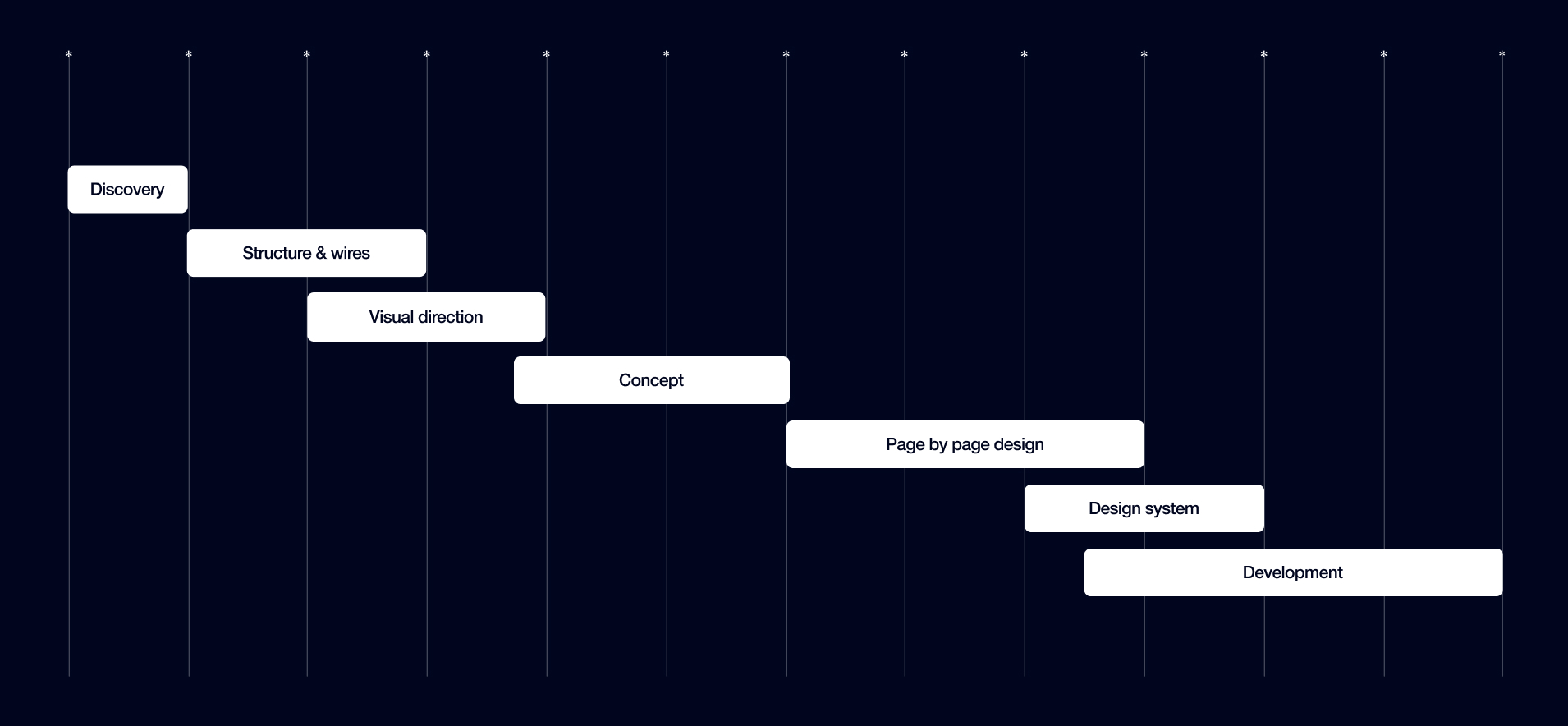
Phase 1 — discovery
Discovery defines what is being built and why.
What happens here:
- understanding business goals and constraints
- defining target audiences
- clarifying positioning and tone
- aligning expectations and success criteria
This phase exists for every project — whether it’s one page or twenty.
Why it’s fixed:
Without discovery, later decisions become guesswork.
Phase 2 — structure & wireframes
Once goals are clear, structure follows.
What happens here:
- mapping pages and navigation logic
- defining user flows
- creating wireframes for key page types
- identifying edge cases early
This stage establishes how information works, not how it looks.
Why it’s fixed:
A website without structure cannot scale cleanly.
Phase 3 — visual direction (moodboard)
Before detailed design, the visual language must be defined.
What happens here:
- exploring visual directions
- defining typography, color, rhythm, and references
- aligning on tone and personality
This step ensures the entire site speaks one visual language.
Why it’s fixed:
Without a shared direction, design becomes inconsistent and subjective.
Phase 4 — core concept (homepage / key template)
This is the most important design checkpoint.
What happens here:
- designing the homepage or main template using real content
- testing hierarchy, tone, density, and first interactions
- validating visual decisions before scaling
At this point, the design system is essentially born.
Why it’s fixed:
Every other page inherits decisions made here.
What the “core” represents
Up to this point, the project behaves like a single high-quality landing page:
- strategy
- structure
- visual system
- component logic
This is the minimum viable foundation for any serious custom website.
Part 2: the scalable phases (where timelines grow)
After the core is approved, timelines stop being fixed. From here on, everything depends on how many unique templates the website requires — and what kind of templates they are.
What we mean by templates in this context
When we talk about templates, we don’t mean ready-made themes or visual presets. A template is a distinct page type with its own layout structure, component logic, and content behavior. Just as importantly, not all templates affect the timeline in the same way.
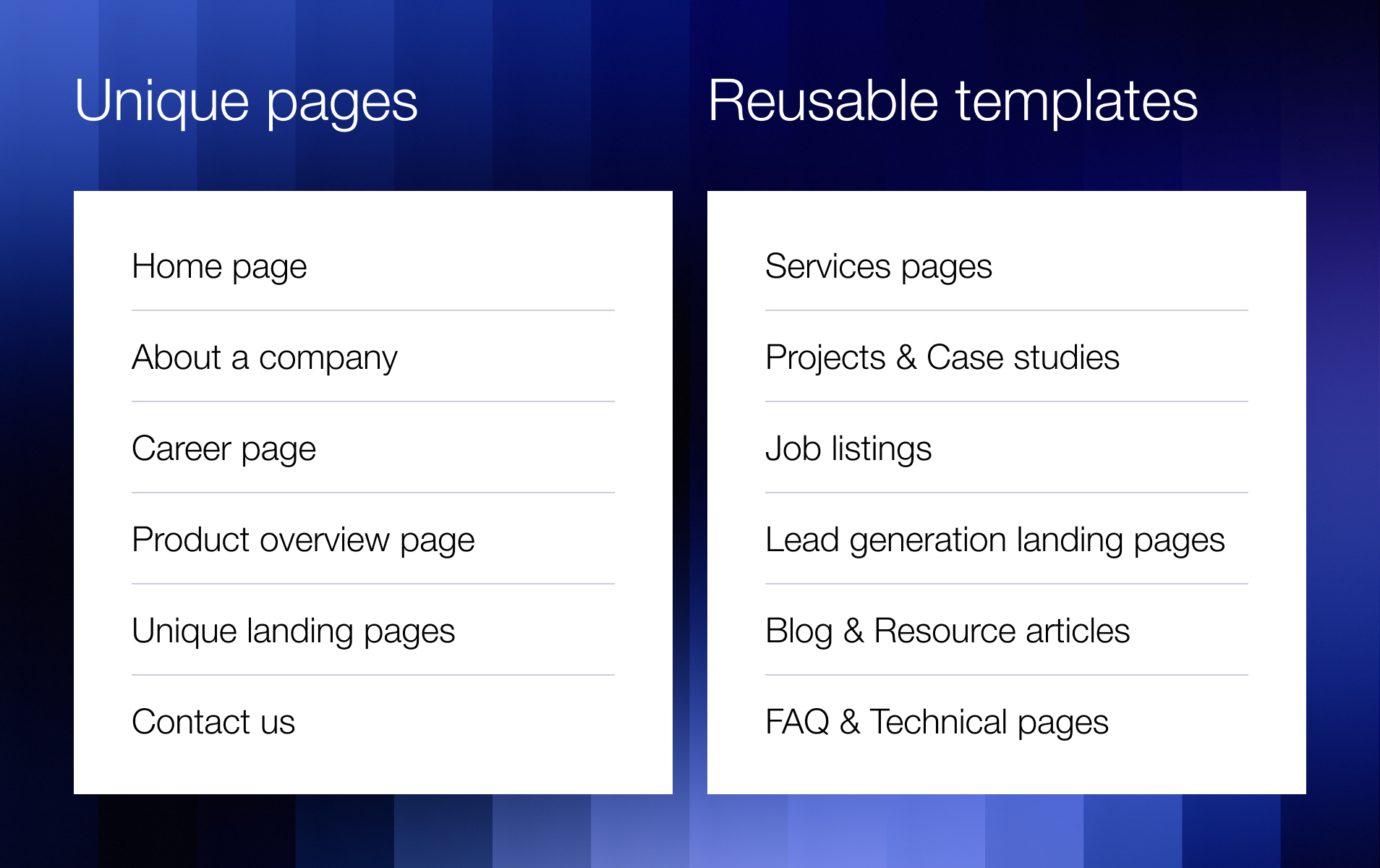
Unique templates (one-off pages)
These are pages that are designed and built once and usually don’t scale further. Examples include:
- about the company
- mission or values
- culture or team overview
- contact page
- legal or policy pages
These pages often have a custom narrative and layout, but they are not reused multiple times across the site. From a timeline perspective, they add limited scope — once they’re designed and built, the work doesn’t multiply.
Reusable templates (scalable page types)
Reusable templates are designed to be used many times, typically through a CMS. Examples include:
- services pages
- case studies or projects
- blog or resource articles
- job listings
- news or updates
These templates require more upfront work:
- flexible layout logic
- multiple content states
- component rules
- edge-case handling
However, once built, they allow the website to grow without additional design or development work.
Why this distinction matters
Two websites can have the same number of pages — and completely different timelines. A website with:
- many one-off pages, and
- only a few reusable templates
will usually move faster than a site built around several complex, reusable content types. Timeline estimation isn’t about page count — it’s about how many structurally different templates need to exist.
Phase 5 — page-by-page design (scales with templates)
This is where scope truly starts to matter. Each new unique template introduces:
- new layout decisions
- new component combinations
- new content logic
- additional responsive states
Phase 6 — design system, specs & handoff
Before development begins, everything must be structured properly. What happens here:
- organizing the Figma file
- defining components and states
- preparing responsive versions
- documenting interactions and motion
This phase scales with complexity, but less aggressively than page-by-page design.
Phase 7 — development (also scales with templates)
Development does not start from zero for every page — it builds on the core. However, each unique template still adds:
- layout implementation
- CMS logic
- interaction handling
- QA effort
A website with multiple complex templates cannot realistically be developed in “2–3 weeks” without sacrificing quality. Development scales in parallel with design complexity.
So… how long does a custom website take?
A more accurate way to think about timelines is this:
- core phases → relatively stable
- each additional unique template → adds time to both design and development
Instead of asking:
“How many weeks will it take?”
A better question is:
“How many unique templates does this website need?”
That answer determines the timeline.
What this means for clients
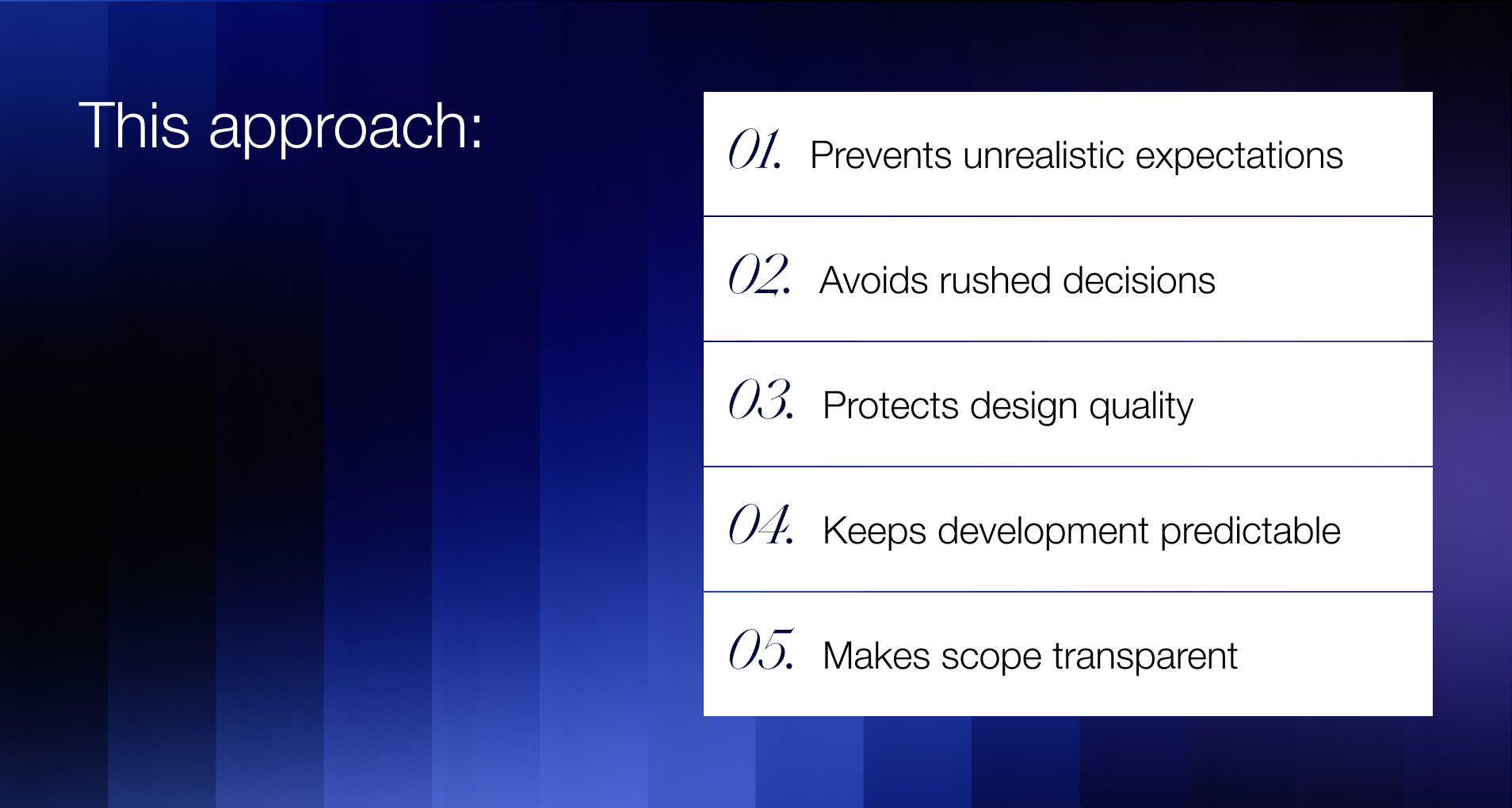
This approach:
- prevents unrealistic expectations
- avoids rushed decisions
- protects design quality
- keeps development predictable
- makes scope transparent
It also explains why timelines can’t be reduced to a single number without context.
At Snig Digital, we design visually strong, custom websites that are meant to last — not quick template builds. Our process is structured to:
- establish clarity early
- lock decisions at the right moments
- scale cleanly with scope
- avoid redesigns six months later
This is how complex, design-driven websites stay coherent — and why their timelines make sense.
Planning a website and want a realistic timeline?
If you’re considering a custom website and want to understand:
- what’s fixed
- what scales
- and where time is actually spent
We’re happy to walk you through it. 👉 Book a 30-minute intro call
Let’s define the core first — and scale responsibly from there.
.jpeg)
.jpeg)